Ofsted's Inspection Framework for Supported Accomodation
Supported Accommodation Software and Ofsted's Inspection Framework
The introduction of Ofsted registration for supported accommodation services in England marked a significant shift for the sector. Providers who had operated under relatively light oversight found themselves subject to a formal inspection framework with published standards, enforceable requirements and the full weight of regulatory consequence that comes with them.
For providers who had invested in purpose-built supported accommodation software, the transition was manageable. For those who had not, the inspection process exposed the gap between what informal systems appeared to provide and what a regulatory framework with real teeth now required. Understanding what Ofsted's framework examines, and how software either supports or undermines the ability to meet it, is a practical necessity for every provider in this sector.
What Ofsted's Framework Assesses in Supported Accommodation
Ofsted's inspection framework for supported accommodation assesses providers across several key areas. The quality and impact of support is central, with inspectors examining the extent to which young people's needs are understood and met, whether support plans are genuinely personalised, and whether progress is being achieved and documented. Inspectors also assess how effectively leaders and managers govern the service, how risk is identified and managed, and how the provider ensures that young people are safe.
Each of these judgement areas generates specific documentation expectations. Support plans must be individual, regularly reviewed and demonstrably connected to the young person's goals. Risk assessments must be current and dynamic. Records of support sessions must show what happened and what it achieved. The management record must demonstrate effective oversight, not merely its intention.
Supported accommodation software designed to make meeting these expectations a natural outcome of good daily practice gives providers a fundamental advantage. When the platform structures records around the inspection framework's requirements, the evidence Ofsted needs is produced as a byproduct of running the service well.
Support Planning That Meets the National Standard
Support plans in supported accommodation are scrutinised more closely under the national standards than many providers initially expect. Ofsted does not look for a completed template. It looks for a plan that is clearly specific to the individual young person, that reflects their stated goals and preferences, that has been reviewed and updated at appropriate intervals, and that the young person themselves has meaningfully contributed to.
Generic plans that could apply to any 17-year-old in supported accommodation do not meet this standard. Plans completed thoroughly at placement and left unchanged for six months do not meet it either. The inspection framework looks for evidence that support planning is a continuous process rather than a document produced once and filed.
Supported accommodation software should structure planning as an active, regularly reviewed process with prompts for review at defined intervals, a clear record of the young person's involvement at each stage, and a version history that shows how the plan has evolved. Sue Solutions builds this into the supported accommodation platform as a core function.

Risk Management Under Inspection Scrutiny
Risk management is one of the areas where Ofsted's framework places the most specific demands on supported accommodation providers. Inspectors expect to see risk assessments that are current, that reflect the real risk profile of each young person at the time of inspection, and that demonstrate active management rather than initial identification followed by inaction.
The practical challenge is that in an independent living environment, risk profiles change between visits. A young person's mental health, their relationships, their financial situation and their engagement with the service can shift significantly between weekly support sessions. Risk assessments accurate at the start of a placement may be substantially out of date by inspection day.
Supported accommodation software that treats risk assessment as a dynamic document, with review prompts, escalation pathways and a record of how risk management has evolved, provides the evidential foundation Ofsted expects. Static risk assessments stored in filing systems or shared drives do not.
Demonstrable Management Oversight
Ofsted's framework pays significant attention to the quality of leadership and management, and specifically to whether leaders can demonstrate, not just assert, that they have effective oversight of their service. A manager who says the service is performing well needs records to support that claim: how quality is monitored, how concerns have been identified and addressed, how the service has responded to young people's feedback.
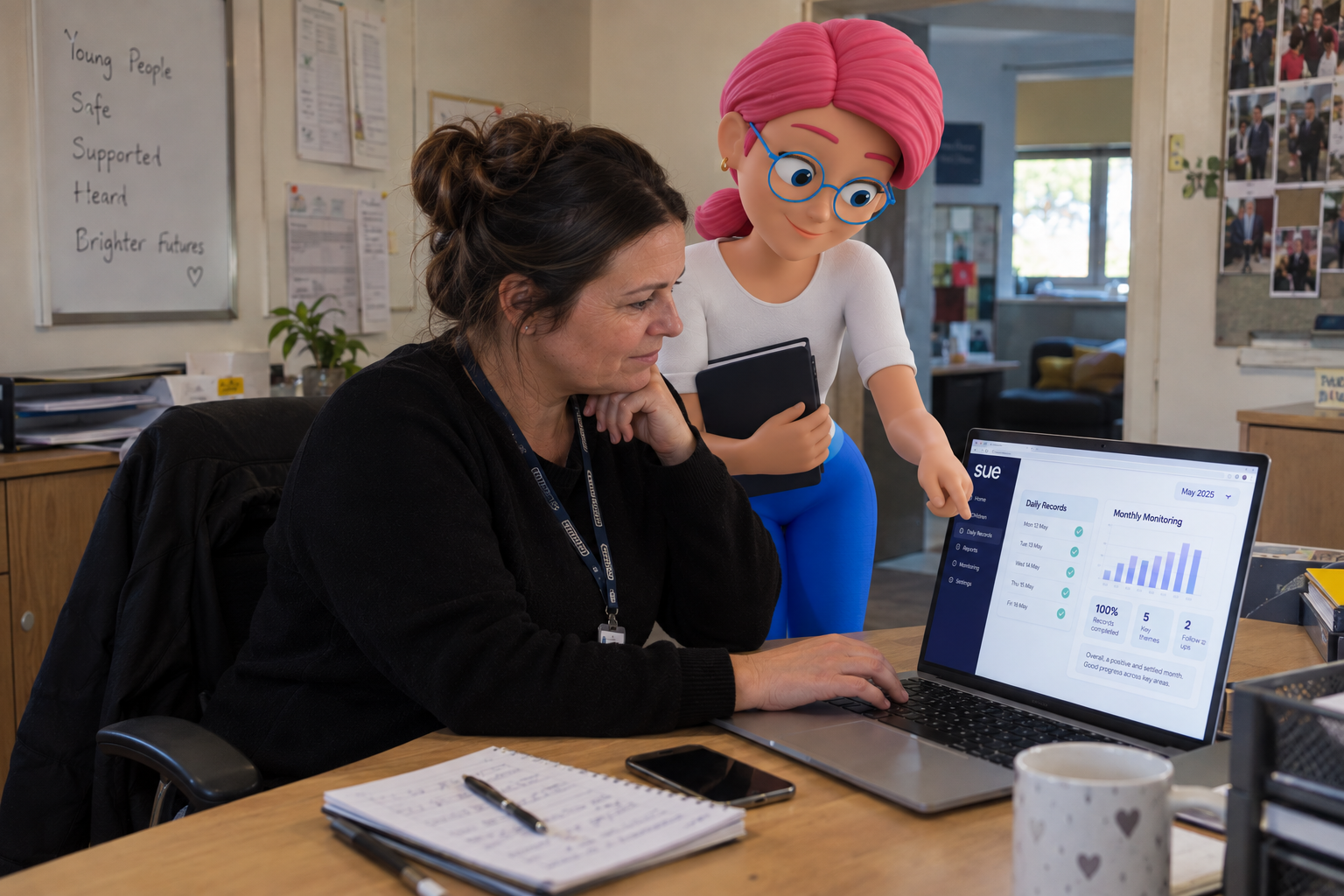
In a well-governed service, all of this is available in the system as a natural output of how the service operates. Sue Solutions gives managers and responsible individuals the governance visibility to make that demonstration convincingly. Dashboards showing completion rates, outstanding actions, review schedules and compliance status across the caseload provide the information that effective oversight requires. More than 1,000 services across the UK rely on this visibility to run well and to evidence that they do.
Building the Evidence Base Before the Inspection Arrives
For providers who registered with Ofsted and continued operating on the same informal systems, the period between registration and first inspection is a window that closes faster than anticipated. Building the record base that an inspection will examine takes time. Support plans that genuinely meet the standard take time to develop. Risk assessments that reflect real understanding of each young person take time to establish.
Providers who move to supported accommodation software early in the registration process have more of that time working in their favour. By the time an inspection is announced, the documentation infrastructure is established, records are consistent, and the evidence base already exists. The inspection becomes an examination of a functioning system rather than an exercise in demonstrating that one was planned.
Frequently Asked Questions
What does Ofsted look for in supported accommodation inspections?
Ofsted inspects the quality and impact of support, the effectiveness of leadership and management, and how well the service keeps young people safe. Specifically, inspectors examine support plans for personalisation and regular review, risk assessments for currency and active management, records of support sessions for evidence of progress, and the management record for demonstrable oversight. The national standards for supported accommodation set out the requirements providers are assessed against.
How can supported accommodation software help with Ofsted registration and inspection?
Purpose-built supported accommodation software structures records around the national standards and Ofsted inspection framework, so that documentation produced in daily practice meets the regulatory standard by design. It gives managers real-time visibility of compliance gaps before they become inspection findings, and builds the evidence base that inspectors examine continuously rather than retrospectively.
What records does Ofsted inspect in supported accommodation services?
Ofsted inspects support plans, risk assessments, records of key work sessions, pathway planning documentation, records of young people's involvement in their own support, management oversight records and evidence of how the service has responded to concerns and feedback. The inspection framework for supported accommodation differs from that for registered children's homes and requires documentation structured around the national standards rather than the Children's Homes Regulations.
Sue Solutions has built its supported accommodation platform alongside the sector's regulatory evolution, working with providers through Ofsted registration and inspection.